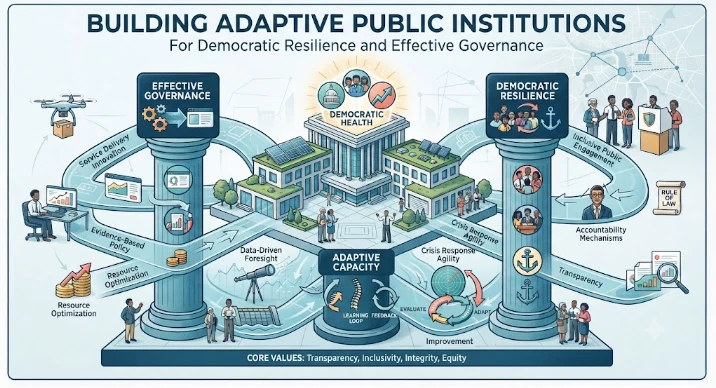
This article describes adaptive public institutions as organizations capable of responding to shocks while protecting democratic values, legal accountability, and public trust. Pandemics, cyberattacks, floods, financial crises, migration pressures, energy disruption, and misinformation require more than emergency continuity; they require learning and adjustment under uncertainty. The article highlights horizon scanning, scenario planning, risk registers, frontline reporting, redundancy, local initiative, central coordination, reliable data, protected scientific advice, and transparent crisis communication. Adaptive institutions also need rapid learning reviews, carefully governed pilots, equitable public participation, legal safeguards, resilient procurement, workforce support, interoperable digital systems, and strong organizational memory. Emergency authority should remain reviewable and temporary, while courts, auditors, ombuds offices, and civil society continue to provide oversight. Evaluation should cover readiness, response, recovery, unequal impacts, service continuity, staff strain, public understanding, and return to normal accountability. The article concludes that resilience requires a stable democratic core combined with flexible methods, allowing institutions to change procedures without abandoning rights, purpose, fairness, or responsibility.
Shocks are more likely to be abrupt for public institutions than are planning processes. When decisions need to be made with uncertainty, it can be influenced by a pandemic, cyber attack, flooding, financial crisis, migration surge, disruption in energy resources, or wave of misinformation. Being resilient is not just about being able to carry on doing what you're doing. This is being able to defend democratic values, to learn from disruption and adjust to it without becoming used to emergency power.
An adaptive institution is aware of change in the early stages. Recognizing weak signals before they become a crisis and collapse can be achieved through horizon scanning, risk registers, scenario exercises, frontline reporting, scientific advice and community observation. There are no guarantees in Foresight. It enables leaders to identify a number of possible scenarios and determine which skills are relevant to them all.
Steering, trust, policy coherence, crisis management, public workforce capacity and protection against misinformation and malign influence were highlighted in the OECD review of democratic resilience in Government at a Glance 2023. The report viewed resilience as a governance issue and not something that is a technical emergency function. Institutions must be fast, but they must also be right and true and responsible, in action and crisis.
Redundancy is a time-consuming fad that will be blamed for inefficiency in quiet times. When we judge the cost of these by their narrow utilization goals, it may seem like they are costly. When we think of these just for how much they are used, they can seem expensive. In disruption, such buffers provide space to be able to act. Administration that is able to handle the day-to-day demands of the job and yet has the capacity to respond when things go wrong with normalcy.
Local initiative may enhance response in the event of local conditions changing. Formulated reports from the frontline offices are frequently delayed or limited by a variety of situations including shortage, public confusion and implementation obstacles. There is flexibility in making adjustments at the local level but there must be common standards for equity and coordination. A robust system is one that has a clear national set of goals, and has authority for context specific action.
Coordination by the center still is important. The sharing of information, equipment, staff and public attention is a challenge in times of crises, as it is a cross-departmental and cross territorial issue. A center of government can help to agree and settle on priorities, conflict and have a common operating picture. The problem with coordination is that if every little thing needs to be approved from the center, it becomes detrimental.
Adaptive capacity is based on information quality. Leaders should have the data in a timely fashion, with clear definitions, uncertainty ranges, and with the reporting of missing information. A dashboard can give a false sense of control when indicators are out of time, out of time frame, and affected by incentives for reporting. Decision teams should consider the information chain, missing information and distribution impacts before deciding.
Institutions must be safeguarded to protect and ensure scientific advice. Elected leaders have the responsibility for values and tradeoffs; experts can explain mechanisms, probabilities and consequences. Avoiding methods, uncertainty, disagreement, and conflicts should be made clear on advisory bodies. The confidence in science is lost when science is used as a political shield and when findings which don't fit with the political agenda are lost.
There has to be a differentiation between fact, judgment and revision in the context of an emergency communication. When there is a change in guidance, citizens are capable of accepting it as it is because officials will provide them with the reasons and explanations for the change. Sounding certain comes across as weak confidence, which is disappointed when it's corrected. Information is updated regularly, is presented in a way that can be understood by everyone, is delivered in multiple languages, and sources are visible and accessible, helping people to make decisions in times of confusion.
In adaptive institutions, learning is continual and happens while action is taking place. Rapid review meetings can be used to discuss assumptions and outcomes, determine harmful unintended consequences and adjust procedures. To meet such learning needs, psychological safety is needed, as staff will hide problems when all mistakes will be punished. Responsibility must be upheld for negligence or misconduct but a good honest mistake should be considered, not ritualised, blame.
Adaptation can be supported via experimentation via limited pilots. Agencies need be able to experiment with service designs, communications, procurement mechanisms or coordination models before they are adopted on a broad level. Pilots require ethical guards, some minimum standards, comparison, and definite no go rules. It must be fair to vulnerable communities to not bear undue burden simply because it is easier to implement in low power settings.
Increases public participation leads to increased knowledge in adaptation, which is not available within agencies. Any community concerns and suggestions for unrealistic rules can be reported, and residents can state why some groups may not be able to get emergency assistance. Community groups can be credibles information partners. The participation process should have an impact on the decision-making process, and not be used as a tool to achieve adherence to predetermined plans.
Equity needs to be on the front page in times of crisis. Stable housing, flexible work, standardized documentation and private transport are often essential for fast action, which must also be based on digital applications. This assumes that everyone can speak English, is not a person of poverty, disability or displacement, etc. A distributional analysis can be used to identify those groups that are being protected and those that are taking on hidden costs.
Improvisation undermines rights and the legal preparedness must combat it. The legal basis and review of emergency authority, exceptions to procurement, data sharing, movement exceptions and surveillance is needed. Permanence is curtailed by sunset clauses and by legislation. While in times of disruption, courts, auditors, ombuds offices and civil society groups are vital, not only in a post-disruption environment.
Skill, health and trust are the three elements of workforce resilience. Cross training, clear role, protective equipment, mental health support, realistic workloads are all needed by public servants. Leadership should be aware of the critical positions and succession plans before the absences get to a level of seriousness. The lack of staff vigor causes diminished judgment, service and knowledge.
Flexible protection measures need to be put in place within procurement systems. The simple rules aren't fast enough when something is pressing and uncontrolled buying when an emergency arises can lead to waste, favoritism and bad quality. A middle ground is a prequalified supplier, a framework agreement, price monitoring, transparent awards and in a later stage audit. Supplier diversity minimizes reliance on a single supplier and location.
Protection against cyber threats is not the only component of digital resilience. The systems, methods, and processes that agencies must rely on must be interoperable, offline, backed up, secure, and have manual processes for critical services. There are some failures in technology that can be caused by attack, loss of power, failure of a vendor or just being overloaded. Trustworthy platforms can fail in any manner at any time and continuity planning should take this into account.
Crisis teams have a tendency to break up and organizational memory is lost. Structured documentation is required for decisions, workarounds, wrong assumptions and community feedback. After action reviews should be owned and should be assigned deadlines – they should not be reports for the sake of report. Capacity building and refreshed procedures transforms experience.
Political turnovers is the next step to gauge if adaptation is becoming permanent. A resilient institution cannot be focused solely on the leadership of any one person and his or her response style under emergency. Continuity is provided by laws, professional norms and cross-party agreements, standing partnerships and career expertise. Meanwhile, overinsulation can keep out of the way practices from being corrected by the public.
The outcomes of readiness, response, recovery and reform should be measured. The indicators measure service continuity, decision time, error, unequal impact, strain on staff, knowledge of the public, and return to normal oversight. Coordination failure and informal innovation can be revealed using qualitative accounts. Comparative review across regions allows to distinguish between what works in the local context and what can be transferred to other regions.
Trust is a process which is both an input and an output. People that value competence and honesty are more likely to abide by the instructions to be protected, to share information and to deal with the temporary disruption. During a crisis situations, institutional actions can reinforce or dis-empower that trust. Dutifulness, reactivity, transparency, equity and honesty should be seen in action in times of stress.
Adaptation should be not an ongoing instability. Staff and citizens require clear rules and boundaries, authority and services that are predictable. The desired outcomes are a stable core and flexible methods (rights, purpose and accountability continue to be strong, and procedures are flexible to adapt to changing circumstances). This balance is the one that is missing from innovation language to avoid any arbitrary change.
Intergovernmental mutual aid is an increase in capacity outside of one jurisdiction. Neighboring authorities can support one another through the use of agreed equipment, staff arrangements, agreed data standards and through the rehearsed process of requests. Agreements should be fairly rewarded, and rules that prioritize regions that are affected by crises should be adopted to ensure that they are not at a disadvantage.
Adaptive design does a public finance need? A flexible approach towards response – reserve policies, contingency budgets, quick transfer systems and clear emergency accounts provide leaders with flexibility to respond without the murky effect of spending. Fiscal flexibility needs to be coupled with real-time disclosure and in turn independent review. A resilient budget does not only safeguard essential services but also ensures a clear documentation of deciding on extraordinary choices.
Resilience is visible in the democratic process when institutions withstand shocks and do not lose their ability to maintain and uphold public values. The elements of adaptive capacity are foresight, buffers, distributed initiative, protected expertise, learning systems, legal safeguards and inclusive partnership. There is no uncertainty in any design. Founded institutions engage in uncertainty as a public matter, take actions responsibly and re-establish the normalcy of accountability as soon as extraordinary actions are no longer necessary.
CITE THIS ARTICLE
Das, B. C. (2025). Building Adaptive Public Institutions for Democratic Resilience and Effective Governance. https://www.bikashchandra.com/article/4adb6f12-dcc2-51d1-a208-5663d14aaf16
B. C. Das, “Building Adaptive Public Institutions for Democratic Resilience and Effective Governance,” 2025. [Online]. Available: https://www.bikashchandra.com/article/4adb6f12-dcc2-51d1-a208-5663d14aaf16
Das, B. C. (2025) ‘Building Adaptive Public Institutions for Democratic Resilience and Effective Governance’. Available at: https://www.bikashchandra.com/article/4adb6f12-dcc2-51d1-a208-5663d14aaf16
Das, Bikash Chandra. “Building Adaptive Public Institutions for Democratic Resilience and Effective Governance.” 2025, https://www.bikashchandra.com/article/4adb6f12-dcc2-51d1-a208-5663d14aaf16.
Bikash Chandra Das. “Building Adaptive Public Institutions for Democratic Resilience and Effective Governance.” (2025). https://www.bikashchandra.com/article/4adb6f12-dcc2-51d1-a208-5663d14aaf16.
Das BC. Building Adaptive Public Institutions for Democratic Resilience and Effective Governance. 2025. https://www.bikashchandra.com/article/4adb6f12-dcc2-51d1-a208-5663d14aaf16
@misc{article_4adb6f12dcc251d1a2085663d14aaf16,
  title = {Building Adaptive Public Institutions for Democratic Resilience and Effective Governance},
  author = {Bikash Chandra Das},
  year = {2025},
  url = {https://www.bikashchandra.com/article/4adb6f12-dcc2-51d1-a208-5663d14aaf16},
}
TY  - GEN
AU  - Bikash Chandra Das
TI  - Building Adaptive Public Institutions for Democratic Resilience and Effective Governance
PY  - 2025-03-12
UR  - https://www.bikashchandra.com/article/4adb6f12-dcc2-51d1-a208-5663d14aaf16
ER  -
This article explores why people volunteer in America’s national parks and how program design influences whether service remains meaningful. Volunteer motivations often overlap and include personal values, learning, social connection, career development, confidence, purpose, and attachment to place. The article uses motivational frameworks to show that volunteers are more likely to remain engaged when they experience autonomy, growing competence, respectful relationships, and a clear connection
Probation and parole are presented as essential community-based alternatives to incarceration that combine supervision, accountability, and reintegration. Probation generally allows eligible offenders to remain in the community instead of serving a prison sentence, while parole provides conditional release after part of a custodial sentence has been completed. The article explains that both approaches can preserve employment, family ties, education, and housing, all of which reduce the risk of r
This article defines the ethical boundaries that protect volunteers who support visitor safety and law-enforcement-related functions in national parks. Although volunteers can assist with information, observation, traffic support, administrative work, backcountry roves, and reporting hazards, they must not exercise powers such as arrest, detention, search, citation, evidence handling, use of force, or other commissioned enforcement duties. The article emphasizes clear position descriptions, accu