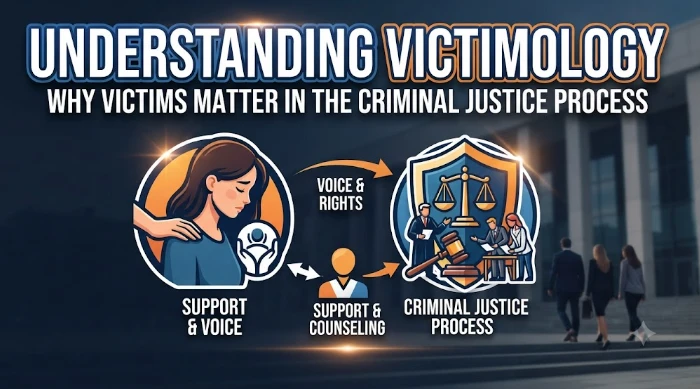
Victimology places the experiences, needs, and rights of victims at the center of criminal justice rather than treating them only as sources of evidence. The article explains that victimization can produce economic, psychological, social, and physical harm, while many offenses remain hidden because victims fear stigma, disbelief, retaliation, or secondary victimization by institutions. It also highlights how gender, social marginalization, cybercrime, and financial fraud shape different victim experiences and reporting patterns. Ignoring victims weakens crime statistics, community trust, and the effectiveness of law enforcement, while also increasing long-term social and economic costs. The article presents victim impact statements, restorative justice, and automated referral systems as important victim-centered responses. These mechanisms allow survivors to communicate harm, access legal and psychological support, and participate more meaningfully in justice processes. Overall, victimology broadens the meaning of justice by emphasizing protection, restoration, dignity, and empowerment alongside punishment and prosecution and ensuring that victims remain recognized as central stakeholders throughout the justice process.
The criminal justice system has been over the years more or less a high-stakes drama wherein only two figures appeared to count: the State and the Defendant. This can be seen as the victims being moved to the periphery virtually becoming just mere evidence with their experiences becoming secondary to the process of prosecution. However, as we move forward through, there is an increasing awareness that this method does not consider an important aspect of the justice, which is the victim of crime. The scientific study of victims and victimization has ceased to be a peripheral issue in criminology and has become a major consideration in policy making, practice and trust between communities. In an era where AI-based financial offenses, online frauds, and intricate social interactions are becoming an ever more prevalent issue of concern, it is no longer an ethical consideration of who falls prey to it, how it occurs, and what the aftermath entails, but rather a systemic requirement. The stereotypical definition of crime as an observable, violent experience does not reflect the fact that the damage is sometimes very subtle, invisible, and has a spectrum of effects that may be economic, psychological, and social.
The magnitude and the intricacy of victimization highlight the importance of victims. Illegal financial activity became astronomical in the world, and the Global Financial Crime Report of estimates the losses of $4.4 trillion simply last year and is triggered by fraud, scams and new cyber threats. Although these figures are frightening, they also represent the stories of the people who are losing their life savings, employment or personal security in the background of the statistics. In the neighborhood, Australian Bureau of Statistics figures of 2024-25 also paint an equally grim picture. Approximately, 3.9 percent of the population aged fifteen years and above were at least one personal crime, such as assault, robbery, or sexual violence, showing that victimization is not a singular and isolated case.
To most people, the trauma is recurrent; almost half of the victims of physical assault had two or more cases in a year, which increases to 56 percent among women. There are also stark gender differences in the patterns of victimization. Although more often than not men are assaulted by strangers, women are also more likely to be assaulted by someone they know and 44 percent of attacks are perpetrated by a family member or an intimate partner. Such statistics are not just some abstract figures but they are a concealed group of the population whose safety, dignity, and access to justice are threatened.
Although the victimization is a common occurrence, a huge chunk of crime is in the shadow. The concept of the Dark Figure of Crime is often applied by criminologists in cases of crimes that are not reported, and the Dark Figure of Crime is exceptionally high regarding sexual violence victims, with recent studies of late and early indicating as many as 90 percent of victims fail to do so. This silence is caused by a variety of factors, both structural and very personal psychological conflicts. The fear of being victimized a second time is also usual; often, the victim receives cynicism, insensitivity, or even blatant dismissal in the supposedly supportive institutions, arousing even more trauma.
To marginalized groups, the past abuse of the law enforcement system brings a sense of distrust that deters them against reporting. The stigma and shame that victims internalize and societal stigmas also continue to silence victims especially in domestic abuse, hate crimes or sexual violence where the victim then normalizes the presence of abuse or fears the additional stigmas that could harm the victim even more through reporting the situation. These personal and social barriers are not the only factors that contribute to the complexity of the issue; there are practical and systemic barriers as well. Computer crimes and international financial fraud are logistical and jurisdictional impediments which may leave victims feeling helpless because criminals seem out of reach of justice.
Every unsolved crime does not just mean personal pain, but also means a missing bit of intelligence that may be used to prevent and intervene in the crime, thus negatively impacting the response to unresolved crimes.
The outcomes of the lack of attention to the victims are much broader than the personal loss. The effects of victimization have far-reaching consequences in the society in respect of economic, social, and community levels. Victimization can readily be converted into an actual loss of finances; the average reduction in income of domestic abuse survivors is twelve percent, which continues long after the victimization incident. These kinds of losses impact the economy through absenteeism, loss of employment and the long-term financial capabilities leading to a cycle of financial insecurity. In high victimization communities, there is a loss of social cohesion and trust that can result in de-policing that is characterized by residents losing interest in civic life and the neighborhoods becoming susceptible to crime. On a grander level, the financial burden of controlling violence, in terms of policing, judicial process, imprisonment, and treatment, is monumental, to the tune of more than nine trillion dollars in the world. The lack of proper support to the victims further increases the systemic strain, and the cycles of harm continue, as well as the results in the impairment of the credibility and efficacy of the justice system.
In an effort to counter such challenges, a swing back to victim-centered approaches has been picking up in. The contemporary justice systems are beginning to acknowledge that those harmed should also be taken care of. Victim impact statements offer an official way of enabling victims to express through their own language the personal impact of crime to make sure sentencing and remediation consider the human cost. The psychological benefits of restorative justice practices, incorporating dialogue and reconciliation have proven to be measurable, enabling victims to have a sense of being heard and validated and the offenders have the structured opportunities to acknowledge harm. These measures create the feeling of closure and empowerment that cannot be found in traditional punitive systems.
Also, there are technological developments that are helping to provide more immediate and effective support to victims. Automated referral systems are now being used with or without AI connecting survivors with legal help, mental health services, and financial compensation immediately upon incident reporting. This type of integration guarantees the timeliness of response, reduction of secondary damage and enablement of victims to go through complicated processes without bureaucratic delay. These policies also focus on ensuring that justice is done by putting victims at the center to ensure that the aftermath of the crime is mitigated, and the victims are not victimized once more by ensuring improved reporting and support mechanisms.
The implication of victim prioritization is bigger. The use of victim-oriented approaches in criminal justice administration improves the reliability of statistics on crime prevalence and pattern, which results in better law enforcement approaches. It enhances more community confidence on the justice system since people can see that their plight is being heard and that the law offices are not just procedural niceties in response to a human experience. Timely provision of support to survivors also enhances economic and social stability as they are able to sustain their jobs, engage in activities in a community and contribute to productivity in any society. Also, the understanding of victims as major stakeholders undermines the traditional roles of power in a legal procedure, ensuring fairness, equity, and ethical responsibilities. Holistic justice which encompasses the physical, emotional and economic consequences of crime provides a precedent to the norms of society in which injuries are not swept under the carpet or trivialized, a culture of responsibility and communal good is strengthened.
The nexus of technological change and victimology is bringing new dimensions of justice. With the rise of digital platforms, AI, and transnational networks as criminal activities, victims of these crimes would tend to face sophisticated types of harm, which the conventional systems find it challenging to manage. Online harassment, cyberspace crimes, and financial crimes do not relate to the local jurisdictions and require innovative solutions to ensure victims are identified and assisted. Artificial intelligence-based solutions are also utilized to track and stop crimes and even to be able to support the victims in real time. These innovations are essential in filling the responsiveness and access gaps particularly concerning the groups of people that have historically been marginalized or experience systemic barriers. The moral application of technology to victim-centered policies strengthens the value that not only punishment but also active care, protection, and empowerment of the victims is not only essential but also a just action.
Finally, victimology as a field has experienced development that has been an expansion of the definition of justice itself. The prevailing criminal justice systems are no longer judged by the rate of convictions or notions of imprisonment but by their ability to restore, defend and empower those who have been victims of crime. By focusing on victims, systems are able to detect criminal networks more accurately, diminish community relations, and provide the environment in which the society can heal. The experience of the last several years shows that, in the case of ignorance of the victims, the society will pay the price in productivity loss, social disintegration, and lack of confidence to institutions.
By contrast, a victim-focused justice system actively addresses these effects, which guarantees that safety and fairness efforts include both punishment and reparation of victims. Placing these values into law, policy, and practice, will provide a possibility to transform legal systems into tools of restorative justice where the victims can be identified not only as witnesses but as the key stakeholders in the development of safer and more equal societies. The humanity, rights and needs of victims are recognized as essential to the establishment of effective as well as morally legitimate justice systems which strengthens the social contract, which forms the basis of law, order and trust of modern society.
CITE THIS ARTICLE
Das, B. C. (2025). Understanding Victimology: Why Victims Matter in the Criminal Justice Process. https://www.bikashchandra.com/article/8f6967f3-fdcd-55d8-8246-5973e119edce
B. C. Das, “Understanding Victimology: Why Victims Matter in the Criminal Justice Process,” 2025. [Online]. Available: https://www.bikashchandra.com/article/8f6967f3-fdcd-55d8-8246-5973e119edce
Das, B. C. (2025) ‘Understanding Victimology: Why Victims Matter in the Criminal Justice Process’. Available at: https://www.bikashchandra.com/article/8f6967f3-fdcd-55d8-8246-5973e119edce
Das, Bikash Chandra. “Understanding Victimology: Why Victims Matter in the Criminal Justice Process.” 2025, https://www.bikashchandra.com/article/8f6967f3-fdcd-55d8-8246-5973e119edce.
Bikash Chandra Das. “Understanding Victimology: Why Victims Matter in the Criminal Justice Process.” (2025). https://www.bikashchandra.com/article/8f6967f3-fdcd-55d8-8246-5973e119edce.
Das BC. Understanding Victimology: Why Victims Matter in the Criminal Justice Process. 2025. https://www.bikashchandra.com/article/8f6967f3-fdcd-55d8-8246-5973e119edce
@misc{article_8f6967f3fdcd55d882465973e119edce,
  title = {Understanding Victimology: Why Victims Matter in the Criminal Justice Process},
  author = {Bikash Chandra Das},
  year = {2025},
  url = {https://www.bikashchandra.com/article/8f6967f3-fdcd-55d8-8246-5973e119edce},
}
TY  - GEN
AU  - Bikash Chandra Das
TI  - Understanding Victimology: Why Victims Matter in the Criminal Justice Process
PY  - 2025-05-21
UR  - https://www.bikashchandra.com/article/8f6967f3-fdcd-55d8-8246-5973e119edce
ER  -
This article explores why people volunteer in America’s national parks and how program design influences whether service remains meaningful. Volunteer motivations often overlap and include personal values, learning, social connection, career development, confidence, purpose, and attachment to place. The article uses motivational frameworks to show that volunteers are more likely to remain engaged when they experience autonomy, growing competence, respectful relationships, and a clear connection
Probation and parole are presented as essential community-based alternatives to incarceration that combine supervision, accountability, and reintegration. Probation generally allows eligible offenders to remain in the community instead of serving a prison sentence, while parole provides conditional release after part of a custodial sentence has been completed. The article explains that both approaches can preserve employment, family ties, education, and housing, all of which reduce the risk of r
This article defines the ethical boundaries that protect volunteers who support visitor safety and law-enforcement-related functions in national parks. Although volunteers can assist with information, observation, traffic support, administrative work, backcountry roves, and reporting hazards, they must not exercise powers such as arrest, detention, search, citation, evidence handling, use of force, or other commissioned enforcement duties. The article emphasizes clear position descriptions, accu