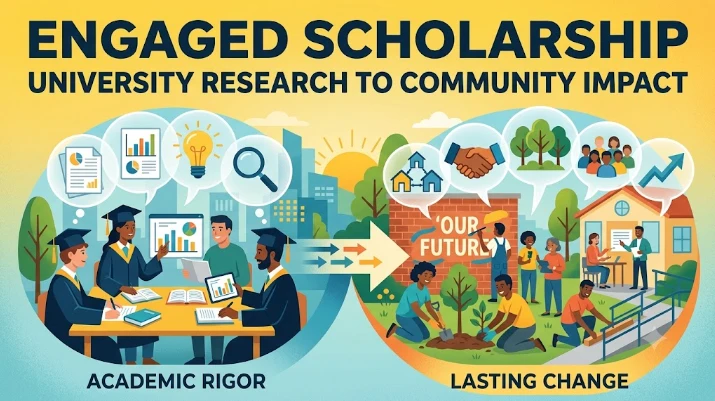
This article presents engaged scholarship as a reciprocal approach to university research in which communities help shape the questions, methods, interpretation, and use of findings. Rather than treating communities as research sites or service recipients, the model recognizes them as sources of expertise and partners in knowledge production. The discussion emphasizes relationship-building before data collection, shared problem definition, appropriate research methods, fair compensation, clear data ownership, and joint interpretation of results. It also stresses that impact should extend beyond academic publications to policy briefs, public meetings, translated materials, maps, training tools, and other accessible formats. Evaluation should consider service improvement, policy change, organizational capacity, trust, participation, and long-term relationships, not citation counts alone. Institutional incentives are identified as a major challenge because engaged projects often require more time and negotiation than conventional research. The article concludes that lasting civic impact emerges when rigorous scholarship, community knowledge, ethical partnership, shared authority, and post-grant sustainability are integrated throughout the research process.
Questions developed in the University research process frequently start in a department, are improved according to the academic literature, and receive funding prior to a meeting with a community partner. The process of engaged scholarship is the opposite of that. It enquires about issues that are important to those who are affected, existing knowledge beyond campus, and what types of enquiries might value-add for all involved. The outcome is not feeble scholarship, it is scholarship that is challenged.
Community Engagement is defined as the mutually beneficial exchange, partnership and reciprocity between higher education institutions and broader communities in which both parties contribute to the shared mission, vision and values, Carnegie Framework. That's a definition that is different than engagement and outreach. Knowledge typically flows one way, with questions, methods, interpretation and benefits going a number of ways in outreach. The community is no longer a place to get services from the University, but actually a source of expertise.
Five principles for engaged scholarship were identified through a large scale scoping review of engaged scholarship: engaged scholarship demands rigorous scholarship, engaged scholarship is a two way street, engaged scholarship involves paying attention to identified community needs, engaged scholarship involves boundary crossing, and engaged scholarship is about democratizing knowledge. These principles link the quality of education and social responsibility. It is still important to be careful when designing rigor, when analyzing rigor and when putting constraints on rigor. Engagement is another test because it inquires of the work: Does it demonstrate relevant past experiences and lend itself to responsible action?
Thomas Andrew Bryer has presented a model of public administration that aims to engage and inspire public citizenship and community within the realms of research and teaching. This action agenda is appropriate for engaged scholarship since public problems rarely are solved by publications. Evidence needs to be delivered in a manner appropriate to decision making to institutions, practitioners and residents. Academic rigor is concretized in a usable civic process.
Relationship-building is a pre-phase to the data-collection phase of an engaged project, and not the data-collection phase itself. There needs to be a period of discussion between partners, concerning priorities, previous disappointments, available resources, political sensitivities and expected benefits. Trust can be established and roles can be defined in a written contract, but it is only after they have been signed will trust be established. Being consistently on time, having a good sense of communication and respecting local schedules is important and more important than having pretty language.
The problem definition is shared, changing the nature of the research. A university group researching food access might start by examining the distance to grocery stores, while food access barriers identified by residents might be transport cost, disability access, work schedules, safety, and culturally appropriate food. Local insight is not a substitute for measurement! It helps to enhance the model by identifying variables that an external team may not have looked at.
The method of selection should be based on the problem and partnership. Surveys can provide estimates of prevalence, interviews can give insight into experiences, administrative records can depict the service pattern and observation can give insights into the way the rules are applied in reality. Participatory mapping can link spatial information and knowledge with the knowledge base of the community. When the intervention cannot be tested with a randomized controlled trial design, or when there is not an adequate comparison, a quasi-experimental or an experimental design will be used to test the intervention.
Recruitment shouldn't be the extent of community participation. Partners can assist in the design of the questions, test how questions are worded, determine trusted places to ask the questions, interpret unexpected results, and determine how the results are communicated. This helps to eliminate unnecessary mistakes and can enhance the quality of the responses. Shared authority is particularly significant in the case of a stigmatized group or politically sensitive issues.
Ethical Design involves compensation. Frequently, community organizations provide free staff time, meeting space, translation, transport, recruitment, emotional labour and more without being fairly resourced. When people feel they are receiving free assistance, it further perpetuates inequality. The expertise of outside the campus should be taken seriously as budgets are prepared and technical consulting.
It is important to have a pre-agreement on data ownership. A scientific dataset can also be of interest to business, carry legal risk and cultural significance. Partners should determine who will be responsible for keeping the information, who will have the authority to approve future uses of the results, which will need to be carefully shared with the community, and how community members can obtain results. There are many collective questions and concerns that can only be resolved with consent forms.
Interpretive involvement prevents socially misleading conclusions and that which is statistically neat. Either reduced need or local partners may know that new documentation rules prevented attendance to the program may be interpreted as a decline in program attendance. An apparent failure of intervention might be due to issues of transport, or staff turnover, and not be due to a faulty idea! Joint interpretation can aid in the identification of the mechanisms that are not apparent from the outcome.
The dissemination of information should not only be in the journal article. There are various types of policy briefs and they can be targeted at different audiences, such as public meetings, translated summaries, interactive maps, exhibitions, training materials, podcasts and technical tools. Accurately needs to be produced in each format, but it should not be confused with accessibility and the need to simplify. The right kind of writing can retain complexity and stave off unnecessary academic obstructions.
There are many ways of measuring impact that need to be broader than citation counts. Services may be affected by a project, in terms of either service design or creating a public debate, or in terms of organizational capacity, funding priorities, professional practice, or community confidence. In some cases effects happen within a short period of time, in others, years are needed to create institutional change. Relationships and changes after funding ends, unintended consequences of evaluation, and intermediate changes are captured in strong evaluation records, as are immediate outputs.
These may be quantitative measures such as participation, uptake of services, adoption of policies, response time, and exposure to the environment, health outcomes, or growth in the network. Qualitative evidence can provide evidence of dignity, trust, conflict, learning and shifts in decision authority. Comparative analysis can compare the outcomes of similar partnerships and can consider why there are differences in outcomes. Process evidence will still be required as there can be many different ways to get the same end result.
The assessment of the quality of the work carried out by the community partners should be done within quality assessment. Theory, methods and contribution to a field can be judged by academic peers and relevance, reciprocity, conduct and practicality by partners. Both of these points of view are incomplete on their own. A mature review process acknowledges several types of expertise and doesn't compromise the quality of the process for anyone.
Often institutional incentives are in opposition to this model. Engaged projects have long time horizons, need to be maintained over time, can have multiple outputs and are negotiated. But promotion systems are usually designed to encourage the quick publication of projects in traditional journals. Academic faculty may be expected to provide significant service in the area of civic service without any formal recognition. Reward policies for universities that want to make a public impact should acknowledge the importance of high-quality service, research and teaching related to the community.
Students are able to give energy and analytical skill; but student involvement must be prepared. Practice sites should not be used by community teams that have had little experience in using them and are given rigid assignments with short semesters. Student participation can be productive when it is clearly supervised, planned for continuity, is a process of reflective learning, and is under the control of its partners. A lack of design pushes the teaching burden from the universities to overburdened organizations.
There is no way to wield power outside of engaged scholarships, but engaged scholarships can be made visible through power. Universities frequently determine who can receive funds, who can grant degrees, and how to provide legal assistance, publications and research facilities. The implementation capacity, legitimacy and access to the community are typically controlled by community partners. Language that implies that both partners would have the same influence makes for unbalanced discussions, and an honest discussion of such assets will help to prevent that.
Don't assume that if there is conflict it means that it is not a successful partnership. When there are disagreements about priorities, about how to interpret something, about who should be credited for what, or about whether something should be made public, there may actually be real differences going on but they are masked in the polite meeting. Good governance sets up mechanisms to revisit decisions, to keep track of and provide for differing opinions, and to safeguard those who are vulnerable. Room for refusal, revision and criticism is needed for reciprocity.
Planning for post-grant is a key component to sustainability. Equipment requires maintenance, community staff requires access to final tools and there are unanswered questions which must have a home. An exit plan should detail what activities are still going on, who is still taking over the responsibilities and how they will be contacted going forward. There is a possibility of maintaining useful work without dependency by using continuation funds, documentation that is opened and has a local trained custodian. Caringly lets trust go and avoids another piloted program from being just another unfulfilled pledge.
Engaged scholarship turns to a long lasting community impact when the research is integrated into a system of collective learning. The questions that emerge are based on real problems, the methods involve both the technical and local knowledge, the findings are returned in usable forms and the evaluation follows change outside the campus. No one knows exactly how civic change will occur since it depends on institutions, resources and politics. The activity allows for accountability to be seen at all points in the inquiry and action. Nevertheless, the process of knowledge creation, to collective capacity and responsive action is a disciplined one that can be taken through reciprocal scholarship.
CITE THIS ARTICLE
Das, B. C. (2025). Engaged Scholarship: Turning University Research into Lasting Community Impact and Civic Change. https://www.bikashchandra.com/article/ab2fd4ba-40e7-5ccc-bbc3-567daafadfa6
B. C. Das, “Engaged Scholarship: Turning University Research into Lasting Community Impact and Civic Change,” 2025. [Online]. Available: https://www.bikashchandra.com/article/ab2fd4ba-40e7-5ccc-bbc3-567daafadfa6
Das, B. C. (2025) ‘Engaged Scholarship: Turning University Research into Lasting Community Impact and Civic Change’. Available at: https://www.bikashchandra.com/article/ab2fd4ba-40e7-5ccc-bbc3-567daafadfa6
Das, Bikash Chandra. “Engaged Scholarship: Turning University Research into Lasting Community Impact and Civic Change.” 2025, https://www.bikashchandra.com/article/ab2fd4ba-40e7-5ccc-bbc3-567daafadfa6.
Bikash Chandra Das. “Engaged Scholarship: Turning University Research into Lasting Community Impact and Civic Change.” (2025). https://www.bikashchandra.com/article/ab2fd4ba-40e7-5ccc-bbc3-567daafadfa6.
Das BC. Engaged Scholarship: Turning University Research into Lasting Community Impact and Civic Change. 2025. https://www.bikashchandra.com/article/ab2fd4ba-40e7-5ccc-bbc3-567daafadfa6
@misc{article_ab2fd4ba40e75cccbbc3567daafadfa6,
  title = {Engaged Scholarship: Turning University Research into Lasting Community Impact and Civic Change},
  author = {Bikash Chandra Das},
  year = {2025},
  url = {https://www.bikashchandra.com/article/ab2fd4ba-40e7-5ccc-bbc3-567daafadfa6},
}
TY  - GEN
AU  - Bikash Chandra Das
TI  - Engaged Scholarship: Turning University Research into Lasting Community Impact and Civic Change
PY  - 2025-01-08
UR  - https://www.bikashchandra.com/article/ab2fd4ba-40e7-5ccc-bbc3-567daafadfa6
ER  -
This article explores why people volunteer in America’s national parks and how program design influences whether service remains meaningful. Volunteer motivations often overlap and include personal values, learning, social connection, career development, confidence, purpose, and attachment to place. The article uses motivational frameworks to show that volunteers are more likely to remain engaged when they experience autonomy, growing competence, respectful relationships, and a clear connection
Probation and parole are presented as essential community-based alternatives to incarceration that combine supervision, accountability, and reintegration. Probation generally allows eligible offenders to remain in the community instead of serving a prison sentence, while parole provides conditional release after part of a custodial sentence has been completed. The article explains that both approaches can preserve employment, family ties, education, and housing, all of which reduce the risk of r
This article defines the ethical boundaries that protect volunteers who support visitor safety and law-enforcement-related functions in national parks. Although volunteers can assist with information, observation, traffic support, administrative work, backcountry roves, and reporting hazards, they must not exercise powers such as arrest, detention, search, citation, evidence handling, use of force, or other commissioned enforcement duties. The article emphasizes clear position descriptions, accu