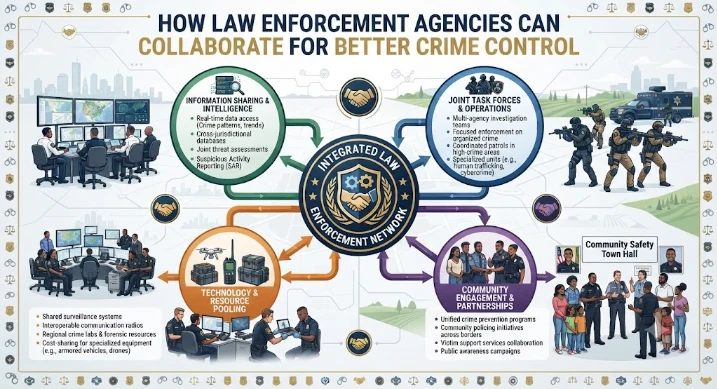
This article explains why cooperation among law enforcement agencies is increasingly important for controlling complex and organized forms of crime. It highlights intelligence sharing as a foundation for identifying criminal patterns, tracking suspects, and disrupting networks involved in terrorism, trafficking, smuggling, cybercrime, and organized crime. In Bangladesh, coordination among the police, Rapid Action Battalion, Border Guard Bangladesh, specialized units, and international organizations is presented as particularly important. The article also discusses joint operations, task forces, shared forensic resources, secure communication systems, and coordinated investigations as ways to improve effectiveness. Regular inter-agency training and debriefing are recommended to clarify roles, strengthen trust, and reduce operational confusion. Collaboration is extended beyond policing to prosecutors, courts, social workers, community leaders, NGOs, and international partners. Because many agencies work with limited budgets and personnel, resource sharing is presented as a practical advantage. Overall, the article argues that integrated cooperation, rather than isolated institutional action, is necessary for timely investigations, effective prosecutions, crime prevention, and stronger public safety.
Enforcing law is an essential part of keeping the society safe and within the realm of law. But in the modern world, which is growing more interconnected and more complex the task of any single agency in combating the increasing variety of criminal activities cannot be done alone. Crime Control could not work effectively without the cooperation of various law enforcement agencies, as well in the national and international levels. In other developing nations such as Bangladesh, where the level of crime is on the increase because of many socio-economic reasons, it is important to ensure the inter-agency coordination working therein is reinforced in order to solve the problems effectively and holistically. By sharing resources, intelligence, coordinating the operations, and creating a common way of dealing with crime prevention and crime investigation, law enforcement agencies can better control crimes.
Intelligence sharing is the first critical element in the partnership between law enforcement agencies. Crime is increasingly being complex and organized whereby it may have cross border aspects including international drug trafficking, human trafficking, terrorism and cybercrime. When this happens, law enforcement agencies in the local areas might not be in position to investigate and arrest criminals due to lack of resources or jurisdiction. It is at this point that the intelligence sharing plays a key role. Through sharing information with other agencies, not only on the local level, but also at the international level, law enforcement will be able to recognize patterns of crime, trace suspects and detect criminal networks that may extend across multiple regions or even countries.
In Bangladesh, whereby organized crime syndicates are increasingly becoming sophisticated, intelligence sharing between different agencies like the police, the Rapid Action Battalion (RAB), the Border Guard Bangladesh (BGB), and other specialized groups needs to be enhanced. In this regard, an example is that the police may have to cooperate with RAB on intelligence regarding terrorism or violent extremism and the BGB might be involved in the exchange of information on criminal activities related to the border such as smuggling and human trafficking. The effectiveness and efficiency of the crime control operation can be enhanced by the development of a centralized system of intelligence sharing, in which all the concerned agencies will be able to retrieve real-time data and analysis. Also, it is important to have an international cooperation with agencies like INTERPOL and local group like South Asian Association of Regional Cooperation (SAARC) to deal with transnational crimes such as drug trafficking and terrorism.
Besides intelligence sharing, other critical elements of inter-agency working are coordinated operations. The control of crime is usually best handled together by the agencies and necessitates the agencies to collaborate in operations of large magnitude that may involve numerous processes or specialized knowledge. By way of illustration, where human trafficking is concerned, law enforcement might be required to operate across local, national, and international boundaries with the view of rescuing the trafficked victims, arresting the traffickers, and destroying the trafficking networks. In the same way, with an organized crime or a drug cartel, various law enforcement bodies with varying jurisdictions and skills all have to cooperate in order to interfere with any illegal activities at all levels, production to distribution.
One excellent example of such a partnership could be the example of joint task forces, which is often created to deal with cases of high priority criminals. In Bangladesh joint task forces of police, RAB and other organizations can cooperate in operation against organized crime syndicates or extremist groups. These task forces are able to exchange resources including forensic teams, surveillance devices, and special staff to conduct complicated operations which would be troublesome to the execution by any single agency alone. The collaboration of agencies allows them to share their experience, minimize the chances of failure, and increase the effectiveness of their work.
In addition, coordination is also required not only during ongoing activities, but also after the crime. In the investigation of a criminal incident, different law enforcement agencies might be required to collaborate to collect evidence, handle investigations and handle suspects. To give a particular example, the police, counterterrorist units, forensic departments and even local intelligence agencies need to collaborate in reconstructing information, tracking down suspects and preparing them to be prosecuted in the event of a terrorist attack or major robbery. In Bangladesh, where the criminal justice system has been sluggish, a better coordination between the various agencies in all the phases of the investigation would help in fastening the process and delivering justice promptly.
Proper communication is also one of the elements of effective cooperation between law enforcement agencies. Communication in a high stress/high risk scenario can be life-saving and garner clarity and directness in communication between all the agencies involved in a crime control exercise, to prevent misunderstandings. This is especially needed in joint operations when several teams are operating within the same area, such as during a hostage rescue operation or a counter-terrorism operation. As a way of enhancing communication, the law enforcement agencies in Bangladesh can adopt secure communication networks, which enable real-time information exchange among the different agencies, and this would eliminate the chances of confusion or delays in responding. Also, frequent inter-agency meetings, debriefings, and training exercises may contribute to communication skills and relationships and create trust between officers of other agencies.
In addition to the working elements, cooperation can be enhanced with the help of collective training programs. Policing bodies should be ready to deal with a diverse set of crimes, and training drills should include the representatives of various agencies in order to make sure that the officers are fully prepared to cooperate. As an example, the large-scale incidents, including terrorist attacks, natural disasters, or criminal investigations, can be jointly simulated, which will enable the agencies to practice coordinated actions, improve collaboration, and determine where the improvement is possible. Such training activities will be useful in establishing a sense of mutual respect among the officers, clear up of roles and duties, and general effectiveness in the actual field of operation.
Furthermore, the collaboration is also related to the judicial system and other stakeholders that are interested in crime prevention and control. The prosecutors, judicial system, social workers and community leaders are involved in making sure that criminals are put in check and the crime prevention programs are enclosed into the body of the wider social programs. These agencies should work with law enforcement agencies to make sure that arrests result in effective prosecutions, that offenders get rehabilitative services, and that the crime prevention activities should be outside policing. In Bangladesh, the judicial process is slow or sometimes ineffective and therefore it is important to establish better connections between the judicial system and the law enforcement to guarantee the delivery of justice effectively and in time.
The problem of resource constraints is one of the most important obstacles to cooperation in Bangladesh and most of the developing nations. The law enforcers in Bangladesh are usually constrained by financial resources, lack of enough manpower and equipment. Such restrictions result in a poor ability to conduct a large scale operation, invest in sophisticated technologies and have an effective communication system. Reviving agencies can be one way of maximizing available resources in order to overcome these challenges. To mention a few, the agencies can still overcome resource constraints and improve the outcomes through sharing equipment, funding, and personnel during joint operations or task forces. International collaboration can also be used to obtain funding, technical expertise, and even high-tech technologies which are not readily available locally further boosting capacity of law enforcement agencies.
Another crucial role to play in the control of crime is community involvement and cooperating with non-governmental organizations (NGOs). The local communities can give useful intelligence and help in the crime prevention in Bangladesh. In rural areas or a high crime area, community policing programs, in which law enforcement is closely involved with the residents of the area, creating trust and preventing crime, may work. NGOs addressing human rights, domestic violence, and drug abuse can collaborate with the law enforcement agencies to offer support services, create awareness, and eliminate the causes of crime. This community style of work leads to a more holistic crime control approach that incorporates law enforcement into the community and social services.
Conclusively, crime control in Bangladesh, as in any other country, requires the cooperation of different law enforcement departments, among other stakeholders in the society. With intelligence sharing, coordination, enhanced communication, and mutual trust, law enforcement forces can overcome crime complexities experienced in the modern world. Community participation and the joint training programs also add to the effectiveness of crime prevention programs. Due to the increasing criminal activities within Bangladesh, most of them organized crimes, terrorism, and cybercrimes, there is a need to enhance inter-agency cooperation to maintain a more secure and safe society. When the law enforcement agencies collaborate, share resources, and interact with the community to deal with crime in a holistic and integrated approach, the effectiveness of the crime control programs can be greatly improved.
CITE THIS ARTICLE
Das, B. C. (2026). How Law Enforcement Agencies Can Collaborate for Better Crime Control. https://www.bikashchandra.com/article/d9170588-1a00-5cdc-8236-35391b0705d1
B. C. Das, “How Law Enforcement Agencies Can Collaborate for Better Crime Control,” 2026. [Online]. Available: https://www.bikashchandra.com/article/d9170588-1a00-5cdc-8236-35391b0705d1
Das, B. C. (2026) ‘How Law Enforcement Agencies Can Collaborate for Better Crime Control’. Available at: https://www.bikashchandra.com/article/d9170588-1a00-5cdc-8236-35391b0705d1
Das, Bikash Chandra. “How Law Enforcement Agencies Can Collaborate for Better Crime Control.” 2026, https://www.bikashchandra.com/article/d9170588-1a00-5cdc-8236-35391b0705d1.
Bikash Chandra Das. “How Law Enforcement Agencies Can Collaborate for Better Crime Control.” (2026). https://www.bikashchandra.com/article/d9170588-1a00-5cdc-8236-35391b0705d1.
Das BC. How Law Enforcement Agencies Can Collaborate for Better Crime Control. 2026. https://www.bikashchandra.com/article/d9170588-1a00-5cdc-8236-35391b0705d1
@misc{article_d91705881a005cdc823635391b0705d1,
  title = {How Law Enforcement Agencies Can Collaborate for Better Crime Control},
  author = {Bikash Chandra Das},
  year = {2026},
  url = {https://www.bikashchandra.com/article/d9170588-1a00-5cdc-8236-35391b0705d1},
}
TY  - GEN
AU  - Bikash Chandra Das
TI  - How Law Enforcement Agencies Can Collaborate for Better Crime Control
PY  - 2026-06-05
UR  - https://www.bikashchandra.com/article/d9170588-1a00-5cdc-8236-35391b0705d1
ER  -
This article explores why people volunteer in America’s national parks and how program design influences whether service remains meaningful. Volunteer motivations often overlap and include personal values, learning, social connection, career development, confidence, purpose, and attachment to place. The article uses motivational frameworks to show that volunteers are more likely to remain engaged when they experience autonomy, growing competence, respectful relationships, and a clear connection
Probation and parole are presented as essential community-based alternatives to incarceration that combine supervision, accountability, and reintegration. Probation generally allows eligible offenders to remain in the community instead of serving a prison sentence, while parole provides conditional release after part of a custodial sentence has been completed. The article explains that both approaches can preserve employment, family ties, education, and housing, all of which reduce the risk of r
This article defines the ethical boundaries that protect volunteers who support visitor safety and law-enforcement-related functions in national parks. Although volunteers can assist with information, observation, traffic support, administrative work, backcountry roves, and reporting hazards, they must not exercise powers such as arrest, detention, search, citation, evidence handling, use of force, or other commissioned enforcement duties. The article emphasizes clear position descriptions, accu