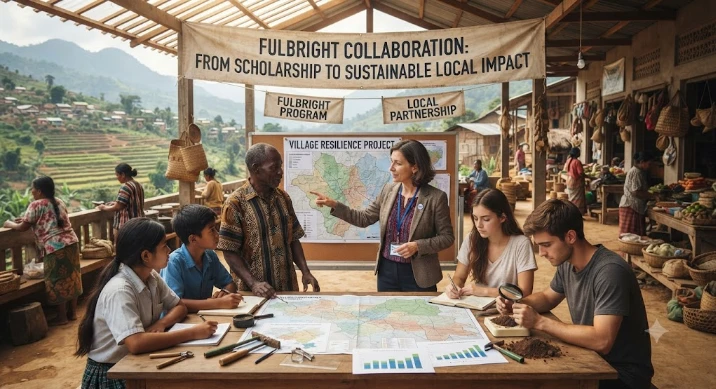
This article examines how Fulbright collaboration can turn international academic exchange into sustainable local community impact. The central argument is that lasting value depends not simply on travel or prestige but on project design, reciprocity, host priorities, institutional ownership, student involvement, and continuity after the grant ends. Strong collaborations begin with dialogue about local needs, political sensitivities, language, data, capacity, and realistic goals. Visiting scholars and host institutions should share decisions about budgets, authorship, communication, teaching, research, and community engagement. The article highlights co-designed curriculum, train-the-trainer models, shared research infrastructure, mentoring, ethical data governance, alumni networks, and follow-on funding as mechanisms for extending impact. It also stresses that short grants require focused objectives and clear exit plans rather than exaggerated claims of transformation. Evaluation should combine participation, research products, trained staff, future collaboration, trust, practice change, and community-defined value. Fulbright becomes a public good when temporary mobility creates durable knowledge, relationships, skills, and locally owned capacity.
An international scholarship can be a wonderful personal experience, or a starting point for lasting change in the local area. The majesty is not the only reason for the difference. Design of the project, the actors involved, the institutions involved and the availability of knowledge after the travel is crucial for sustainable impact. The Fulbright collaboration provides an effective way of studying that transition.
Taking the academic exchange to the center of the program, aiming for mutual understanding. That purpose comes to life when a scholar collaborates with host colleagues and students, public agencies, schools, cultural institutions, businesses and community groups. Research and teaching is still at the core, with an increasing emphasis on community impact beyond the confines of one department. Local value should not be left to chance.
Host-priorities are the bases of a strong project. An expert may come with a new idea that he has perfected, but lacks the institution's most pressing needs. It is important to have initial dialogues to determine local questions, prior work, data availability, language requirements, political issue and realistic capacity. Co-design is a way to avoid having collaboration turn into a visiting scholars personal agenda.
The concept of reciprocity must be given meaning. A host institution provides access, staff, knowledge, credibility, facilities and networks. A visiting scholar provides disciplinary knowledge, external perspective, teaching, labor for research and external contacts. Both kinds of contribution should be reflected in budgets, authorship and public communication and decision rights.
A model to show broad engagement is the Fulbright Scholar-in-Residence model. Host institutions should not restrict a visiting scholar's activities to one academic department or program; they should introduce the visiting scholar to students, faculty, staff and the surrounding community. Exchange can be disseminated through public talks, school visits, cultural events, professional meetings and local media. The most effective activities facilitate learning in both ways.
There should be a relationship between the scholarly core and community involvement. Research can be translated into a public talk, as well as a community workshop can be used to reshape the research question. Barriers to implementation can be identified by local practitioners and assumptions from another country can be challenged by the residents. When Outreach is more than just an additional event but rather informs analysis, collaboration is strengthened.
Trusting will require some period of time, particularly at the level of language, status and institutional culture. Consistent meetings, sharing activities, and consistent follow-through is more effective in developing confidence than a ceremonial greeting is. Partners must have room to converse problems of disagreement and misunderstanding. It doesn't have to be in harmony all the time in an exchange for it to be successful, but it needs to be respectful repair.
Translation is not limited to just language. The calendar, working culture, ethical protocols, teaching methods and decision making timing vary from school to school and country to country. What is one person's normal way of doing something may not be suitable or may be legally prohibited in another setting. Local partners are the interpreters of the systems and local knowledge matters.
Capacity building needs to be avoided to be a one-way training model. Even though workshops may be able to share valuable techniques, visiting scholars must also acquire local techniques. Jointly designed curriculum, joint teaching, joint analysis and mentoring networks lead to reciprocal development. More value is added to a community if multiple participants become skilled, as opposed to one becoming specialized.
The continuity can be supported by train-the-trainer approaches. A scholar develops a program that is highly intensive and involves a small group in the local community, which then passes on to colleagues, students or community partners. Resources should be flexible, translated if required and subject to appropriate permissions. Follow-up support to answer trainers' questions as they arise after initial use.
Research infrastructure can have an impact beyond a grant. Later projects can be supported by a shared dataset, or laboratory protocol, or an archive guide or a survey instrument or a field manual or a digital repository. Infrastructure requires ownership, maintenance, and access rules, as well as stewardship of the data. When no one is trained to maintain equipment, it can be a costly investment instead of a valuable asset.
An example of this is the Fulbright partnership with the United States National Archives – the heritage science. Visiting researchers have been involved with conservation materials, adhesives, textiles and conservation techniques with the conservation specialists and then related this to professional practice and education. The model is integrated with access to the lab and knowledge that can be transferred back to home institutions. The real significance of results is greater than the novelty of technical results.
The Fulbright Arctic Initiative illustrates cooperation in the face of common challenges in the region. The scholars from the Arctic countries have been engaged in research in various fields of health, infrastructure, security, environmental change, indigenous knowledge and sustainable development. Research that is disseminated to the public and in the form of policy recommendations goes beyond writing a paper. Such networks can persist beyond a formal cohort, and relationships and data practices can continue.
Ethical protection of knowledge in the community is needed. Consent, ownership and public release might be issues with research involving Indigenous communities, vulnerable groups, cultural heritage, health or environmental risk. The international status cannot supersede the local authority. Given the sensitive nature of the data, before collection it is important that partners discuss how the data will be shared, cultural sensitivity, credit, and acceptable usage.
Local students are or are not the key agents of impact. Research assistantships, mentoring, joint fieldwork and joint writing build skills and maintains institutional memory. There is a need for students to have meaningful interaction with the visiting scholar instead of only ceremonial interaction. This increased access due to fair selection and compensation ensures that more than just those already well connected in academic circles are able to participate.
An appropriate scope of work for short grants. Trying to change an organisation or community in full during one visit is bound to lead to superficial activities and over-claiming. A focused contribution can be more sustainable – one tested course, one validated protocol, one partnership framework or one locally-owned pilot. Quality and trust is safeguarded by clear boundaries.
Evaluations should start prior to arrival. Theory of change, what partners believe to be the relationship between activities and desired learning, institutional capacity, community benefit, and future collaboration. Baseline data plays an important role in determining whether it is a change or a favourable impression. Indicators should be appropriate to the local context and in relation to the grant period.
Quantitative metrics can be used to monitor participation, usage of the curriculum, research products, trained staff, student advancement, subsequent funding and ongoing collaboration. Practice change, trust, cultural learning and unintended effects can be explored in qualitative interviews. Success should be determined with the involvement of community partners. Local value can only be revealed through prestige measures.
Exit Planning should be a part of project design. Determination of materials, data, equipment, student support, and communication of results should be determined by partners. Any work that has not been completed can be discussed as part of a final handover meeting, where responsibilities can be identified. Departure takes care not to leave relationships hanging when the project is completed, which is often the case with short international projects.
Digital contact can help to continue the collaboration by means of seminars, mentoring, co-writing and project review. Realistic planning is required for time zones, connectivity, workload and security of the platform. An organized moderate plan will tend to stand the test of time more than an aggressive calendar. The exchanges should continue to bring value to both parties, not be based on personal commitment.
Alumni networks can be a way to broaden the local impact across the institutions and generations. Former participants can serve as mentors of new scholars, provide linkages between communities of expertise, facilitate joint proposals and maintain bilateral links when there is political change. The value of a network is dependent on an active purpose. Celebration alone is not enough, and should not be used to substitute for structured opportunities for collaboration.
Often the availability of funding for follow-on work is the deciding factor. Seed grants, institutional matching, community partner budgets and small implementation funds can make a difference in making a good exchange a lasting practice. The local administration and maintenance, not just travel or events, should be included in financial planning. Transparent decisions minimise competition and impression of favours.
In public communication, the impact needs to be shown in a truthful manner. While individual transformation stories draw attention, communities need to learn about how, how much, what remains to be understood and what happens next. Knowledge and results can be fed back to the participants in local language summaries and open events. Claims should not be that a scholar solved a complex public problem.
Staff turnover must not be allowed to erode collaboration, as must be done at the institutional level. Access to agreement, contact records, teaching materials, ethics approvals and project decisions should be maintained for access of authorized colleagues. Partnership should be known by more than one person on each side. A valuable relationship will not be lost upon promotion, retirement or relocation with distributed ownership.
When exchange is shared institutional work, it has sustainable local impact, as is the case with the Fulbright program. Host priorities inform design, inquiry is facilitated by community knowledge, roles for students are valuable and resources are accessible after student leaves. Evaluation, handover, alumni connection and follow-on funding is the way to make a temporary mobility a lasting capacity. International scholarship is at its best as a public good when linkages continue to yield knowledge and actions beyond the completion of a grant.
CITE THIS ARTICLE
Das, B. C. (2025). Fulbright Collaboration: Transforming International Scholarship into Sustainable Local Community Impact. https://www.bikashchandra.com/article/e3e41ba8-1476-556a-b91f-8060254a729a
B. C. Das, “Fulbright Collaboration: Transforming International Scholarship into Sustainable Local Community Impact,” 2025. [Online]. Available: https://www.bikashchandra.com/article/e3e41ba8-1476-556a-b91f-8060254a729a
Das, B. C. (2025) ‘Fulbright Collaboration: Transforming International Scholarship into Sustainable Local Community Impact’. Available at: https://www.bikashchandra.com/article/e3e41ba8-1476-556a-b91f-8060254a729a
Das, Bikash Chandra. “Fulbright Collaboration: Transforming International Scholarship into Sustainable Local Community Impact.” 2025, https://www.bikashchandra.com/article/e3e41ba8-1476-556a-b91f-8060254a729a.
Bikash Chandra Das. “Fulbright Collaboration: Transforming International Scholarship into Sustainable Local Community Impact.” (2025). https://www.bikashchandra.com/article/e3e41ba8-1476-556a-b91f-8060254a729a.
Das BC. Fulbright Collaboration: Transforming International Scholarship into Sustainable Local Community Impact. 2025. https://www.bikashchandra.com/article/e3e41ba8-1476-556a-b91f-8060254a729a
@misc{article_e3e41ba81476556ab91f8060254a729a,
  title = {Fulbright Collaboration: Transforming International Scholarship into Sustainable Local Community Impact},
  author = {Bikash Chandra Das},
  year = {2025},
  url = {https://www.bikashchandra.com/article/e3e41ba8-1476-556a-b91f-8060254a729a},
}
TY  - GEN
AU  - Bikash Chandra Das
TI  - Fulbright Collaboration: Transforming International Scholarship into Sustainable Local Community Impact
PY  - 2025-05-14
UR  - https://www.bikashchandra.com/article/e3e41ba8-1476-556a-b91f-8060254a729a
ER  -
This article explores why people volunteer in America’s national parks and how program design influences whether service remains meaningful. Volunteer motivations often overlap and include personal values, learning, social connection, career development, confidence, purpose, and attachment to place. The article uses motivational frameworks to show that volunteers are more likely to remain engaged when they experience autonomy, growing competence, respectful relationships, and a clear connection
Probation and parole are presented as essential community-based alternatives to incarceration that combine supervision, accountability, and reintegration. Probation generally allows eligible offenders to remain in the community instead of serving a prison sentence, while parole provides conditional release after part of a custodial sentence has been completed. The article explains that both approaches can preserve employment, family ties, education, and housing, all of which reduce the risk of r
This article defines the ethical boundaries that protect volunteers who support visitor safety and law-enforcement-related functions in national parks. Although volunteers can assist with information, observation, traffic support, administrative work, backcountry roves, and reporting hazards, they must not exercise powers such as arrest, detention, search, citation, evidence handling, use of force, or other commissioned enforcement duties. The article emphasizes clear position descriptions, accu