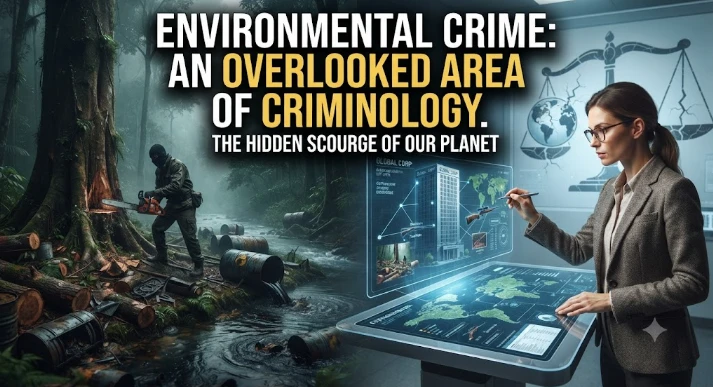
Environmental crime is presented as a major and increasingly organized area of criminality involving illegal logging, mining, wildlife trafficking, hazardous waste disposal, pollution, and exploitation of natural resources. The article argues that these offenses are often wrongly treated as minor regulatory violations even though they generate enormous illicit profits and cause long-term ecological, economic, and human harm. Organized criminal groups use shell companies, document fraud, corruption, money laundering, and international supply chains to disguise illegal resources as legitimate products. Corporate actors can also contribute to environmental harm through unlawful dumping or dangerous industrial practices. Green criminology is introduced as a framework that recognizes ecosystems, species, future generations, and the environment itself as victims of crime. The article highlights stronger environmental laws, international cooperation, satellite monitoring, geospatial technologies, artificial intelligence, and coordinated enforcement as important responses. Overall, environmental crime is framed as a justice and governance issue that demands the same seriousness as other forms of organized crime because it threatens biodiversity, public health, economic integrity, and climate resilience.
In decades, criminology was almost entirely centered on human and material crimes and concentrated on street-level crime, white-collar fraud, and organized syndicates. However, now in , a new horizon of crime that has become the center of global attention is the environmental crime. Having been initially dismissed as a minor violation of the rules or a problem of bureaucrats, environmental crime has now become a highly lucrative and complex crime that endangers not only the life of the ecosystem, economy, or even a citizen. The size of these offenses is tremendous, the methods are highly systematized and the effects are incredibly far-reaching. Since the unlawful dumping of so-called forever chemicals into the waters in Europe such as PFAS, or the massive smuggling of gold in the Amazon, there is an increasing operation of environmental crime at the same scale as the classic transnational organized crime that causes millions of people, wildlife, and whole ecosystems to be affected. It is no longer a fringe issue, but a main problem to the justice system, law enforcement, and global governance.
Environmental crime is of incredible financial scale. According to the reports by the INTERPOL and the United Nations Environment Programme, criminals steal ninety-one billion to two hundred fifty eight billion U.S. dollars of natural resources alone during the year, which shows that these criminal activities are not random cases of taking advantage but organized crimes that bring in massive illegal incomes. The most profitable part of this criminal market is the illegal logging. Criminal gangs are much bigger than smuggling of raw timber, now they employ laundering methodologies, where illegally harvested tropical wood finds its way into legit pulp and paper supply chains. The shell companies incorporated in tax havens are widely used to conceal the sources of the material, and thus, it is very challenging to detect by the authorities of the countries.
In the same vein, illegal mining has been on the increase, owing to the world demand of transition minerals, which are critical in green technologies, including lithium and cobalt, and with high prices on precious metals like gold. The operation Madre Tierra VII carried out by Interpol in late showed that there were massive connections between illegal mining and organized crime resulting in more than two hundred and twenty-five arrests across Latin America. These examples indicate that environmental crime can be in many cases inseparable over the larger criminal network, with a mix of advanced financial transactions, violent implementation, and global logistics.
There is also the increasing problem of wildlife trafficking, which, as the crimes against the elephants or rhinos, tend to be in the headlines. The statistics of early demonstrate that illicit trade of the medicinal and aromatic plants has been growing rapidly. These plants are vital to the regional healthcare, and they are essential to ecosystems, but their harvesting is being done at unsustainable levels in order to supply international markets. The exploitation is not only ecological, but it is an economic one, since the criminal groups can take advantage of high-value products and not be subject to regulation. Of the same concern is industrialization of waste crime. As the cost of disposal increases within high-income countries in , organized crime groups will intervene to dispose of hazardous waste at lower expenses, which will be through dumping of waste in low-income countries. According to UNODC reports, e-waste, plastics, and end of life vehicles illegal flows are producing toxic pollution that is catastrophic in the Global South where there is weak enforcement of the regulations. A good example is the fact that criminals often repackage dangerous products as second-hand goods to avoid customs inspections and this is evidence of how creative criminals are to make money off of environmental pollution yet still avoid the notice of the law enforcement agencies.
In Europe, there is a case that is especially disturbing, the contamination of PFAS, commonly referred to as forever chemicals, because of their environmental persistence. In 2025, investigations in the Netherlands uncovered intentional emissions by chemical plants, as there was a debate on whether negligence by corporations that leads to harm to the environment by the generation should be a high level criminal offense. These happenings bring in the wider question of accountability, the fact that environmental crime is not restricted to the activities of blatantly criminal agents but may also include corporate actors in a sense that their decisions cause ecological and social havoc. Green criminology is a framework that has become dominant in , which is based on a shift in a solely human-centric view to ecological, species, and intergenerational justice. This strategy acknowledges the environment as one of the major victims and emphasizes that the damages to the ecosystems, biodiversity, and the future human populations are ethically and legally pertinent. Green criminology promotes ecological degradation, endangered species, and long-term effects to be viewed as crimes and to be punished and remedied by the justice system by framing the problem of environmental exploitation as a crime.
One can also see how the environmental crime is interconnected with other types of crimes. Crime convergence shows that the crimes related to the environment are often connected with money laundering, corruption, document fraud, and organized crime. The proceeds of illegal logging and mining are usually laundered by using offshore accounts and permits and compliance paperwork can be doctored to give them a facade of legitimacy. This intersection makes it harder to enforce, with criminal actions being cross-sector, cross-region, and cross-legal-jurdictions. The complexity and transnational quality of criminal activity in the environment requires a concerted effort that touches on law enforcement, regulation, and technological development. It also involves the collaboration of the global community because the ecosystems and trade networks are not confined within national borders, and the effects of illegal exploitation spread across continents.
Luckily, is a year of a turning point towards fighting environmental crime on the international level. The 15 th UN Crime congress in Abu Dhabi in April made environmental crimes squarely on the international agenda, an indication that there was a move to incorporate the crimes into the wider UN Convention against Transnational Organized Crime. In Europe, the new Environmental Crime Directive must be introduced by May 21, , by the member states. This order brings in tougher sanctions, broadens the scope of crimes to cover eco-toxic pollution, unlawful recycling, and enhances enforcement procedures within juris dictions. In addition to such legal reforms, under the mentoring of more than fifty countries, INTERPOL Project GAIA is training them to use geospatial technologies, such as satellite images and artificial intelligence, to identify illegal deforestation, mining, and dumping of waste in real time. Such efforts are examples of a strategic move towards proactive surveillance, early warning, and joint enforcement because it is recognized that environmental crime cannot be resolved through reactive policing or national legislation only.
Environmental crime has far-reaching human and ecological impacts that are long-term. In addition to the direct physical devastation, these kinds of crimes undermine the confidence of the people in the institutions and reduce economic opportunities of the people who are affected. Illegal logging, mining and poaching of wildlife denies the governments important revenues and it has been estimated that between nine and twenty-six billion dollars in taxes are lost each year through this activity. Climate change, biodiversity loss, and weakened ecosystems are some of the environmental degradation consequences that impact the current and future generations. Environmental crime is diffuse but persistent in nature, unlike the traditional crimes, which involve attacking an individual or property, and this is the reason why it is one of the most pernicious and difficult fields of criminology and justice in general.
To overcome this increased menace, legislation is not sufficient, it needs to be multi-sectoral. The law enforcement, environmental regulatory bodies, financial regulation bodies and the community stakeholders should work together to seal gaps in enforcement, monitor illegal supply chains and bring both corporate and criminal players to book. Digital forensic tracking, geospatial analytics, and AI-driven monitoring are increasingly important technological tools in intercepting and detecting illegal activities that are intercontinental. Meanwhile, the ecological harm should be considered as the significant offense and the principles of green and intergenerational justice should be applied to the prosecution, sentencing, and restitution.
Anticipated environmental crime in is a clear indication of the necessity to broaden the focus of criminology beyond the common anthropocentric concepts. Justice systems can become more holistic by recognizing the fact that not only can the planet itself become a victim but also its ecosystems, species and future populations. By including environmental protection in the international criminal execution, the illegal exploitation is not only discouraged, but it also brings the law enforcement in line with the overall societal objectives, such as sustainability, protecting biodiversity, and climate-resilience. This change is especially critical because the emerging markets, natural resource needs, and technological development are still colliding with the criminal opportunity, thus posing an incentive to exploit it at high stakes.
Finally, environmental crime is not a crime so victimless or peripheral. It is a multibillion-dollar business that compromises social stability, health, and economic integrity and contributes to the acceleration of the climate crisis and biodiversity loss. The answer to the question in shows that we are now beginning to realize that the planet itself ought to be subjected to the law and that criminal justice systems should begin to respond to this. These threats can be reduced by closing enforcement gaps, exploiting technology, improving international collaboration, and imposing a significant sanction on corporate and criminal actors. With the ecological evils being addressed with the same weight as the normal offenses, society can start breaking down the illegal systems, retrieving stolen resources, and creating a sustainable and fair future of people and the planet.
CITE THIS ARTICLE
Das, B. C. (2025). Environmental Crime: An Overlooked Area of Criminology. https://www.bikashchandra.com/article/fa054161-ee58-58dc-8c76-d151c7047049
B. C. Das, “Environmental Crime: An Overlooked Area of Criminology,” 2025. [Online]. Available: https://www.bikashchandra.com/article/fa054161-ee58-58dc-8c76-d151c7047049
Das, B. C. (2025) ‘Environmental Crime: An Overlooked Area of Criminology’. Available at: https://www.bikashchandra.com/article/fa054161-ee58-58dc-8c76-d151c7047049
Das, Bikash Chandra. “Environmental Crime: An Overlooked Area of Criminology.” 2025, https://www.bikashchandra.com/article/fa054161-ee58-58dc-8c76-d151c7047049.
Bikash Chandra Das. “Environmental Crime: An Overlooked Area of Criminology.” (2025). https://www.bikashchandra.com/article/fa054161-ee58-58dc-8c76-d151c7047049.
Das BC. Environmental Crime: An Overlooked Area of Criminology. 2025. https://www.bikashchandra.com/article/fa054161-ee58-58dc-8c76-d151c7047049
@misc{article_fa054161ee5858dc8c76d151c7047049,
  title = {Environmental Crime: An Overlooked Area of Criminology},
  author = {Bikash Chandra Das},
  year = {2025},
  url = {https://www.bikashchandra.com/article/fa054161-ee58-58dc-8c76-d151c7047049},
}
TY  - GEN
AU  - Bikash Chandra Das
TI  - Environmental Crime: An Overlooked Area of Criminology
PY  - 2025-09-10
UR  - https://www.bikashchandra.com/article/fa054161-ee58-58dc-8c76-d151c7047049
ER  -
This article explores why people volunteer in America’s national parks and how program design influences whether service remains meaningful. Volunteer motivations often overlap and include personal values, learning, social connection, career development, confidence, purpose, and attachment to place. The article uses motivational frameworks to show that volunteers are more likely to remain engaged when they experience autonomy, growing competence, respectful relationships, and a clear connection
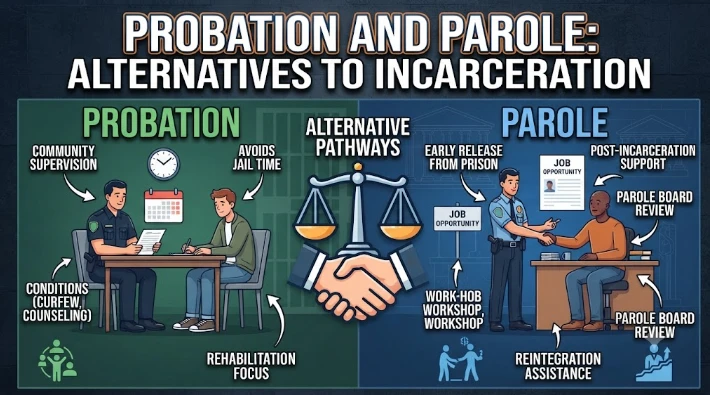
Probation and parole are presented as essential community-based alternatives to incarceration that combine supervision, accountability, and reintegration. Probation generally allows eligible offenders to remain in the community instead of serving a prison sentence, while parole provides conditional release after part of a custodial sentence has been completed. The article explains that both approaches can preserve employment, family ties, education, and housing, all of which reduce the risk of r
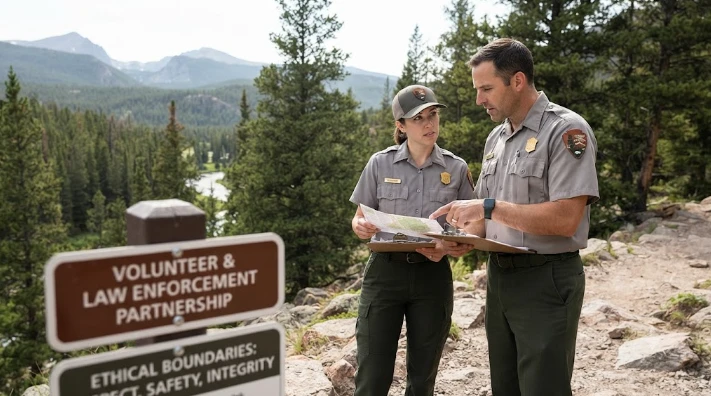
This article defines the ethical boundaries that protect volunteers who support visitor safety and law-enforcement-related functions in national parks. Although volunteers can assist with information, observation, traffic support, administrative work, backcountry roves, and reporting hazards, they must not exercise powers such as arrest, detention, search, citation, evidence handling, use of force, or other commissioned enforcement duties. The article emphasizes clear position descriptions, accu